Core Missions
Core MissionsIn response to the development and needs of Taiwan’s robotics industry, academia, and research sectors, and in connection with the international robotics community, the National Center for AI Robotics
Build Shared Robotics R&D Platforms and Testbeds
Develop national-level hardware and software infrastructure that would be difficult for individual universities or research teams to establish and operate independently.
These shared facilities will support advanced robotics research, system integration, testing, and validation while serving as a national platform connecting research capabilities across academia and industry.
Hardware Platforms
-
Establish digital-twin simulation and training environments with an integrated robotics toolchain.
-
Develop embedded computing platforms for robotics operating systems using domestically developed technologies.
-
Develop embedded platforms, perception and control systems, and robot testing infrastructure.
-
Provide reference designs for mechatronic and mechanical systems.
Software and AI Modules
-
Generative AI for robotics, including LLMs, VLMs, and VLAs
-
Digital twins, Sim2Real, Real2Sim, and Agentic AI
-
Reinforcement learning and other machine-learning technologies
-
Navigation, object detection and tracking, and continual learning
Robotics Testbeds
Establish indoor and outdoor robotics test environments that replicate real-world scenarios, including:
-
Hospitals and healthcare
-
Residential and eldercare environments
-
Disaster prevention and inspection
-
Manufacturing and logistics
-
Search and rescue
-
Smart-city applications
Develop a Shared Platform for Frontier Robotics Technologies
Collaborate with industry, academia, and research institutions to develop cross-disciplinary frontier technologies for robotics.
NCAIR will develop and share reusable robotics technologies, including cloud-computing resources, software modules, source code, datasets, and development tools.
Key technology areas include high-torque-density lightweight actuator modules, advanced tactile sensing, robot perception, control systems, and other critical technologies required for next-generation robots.
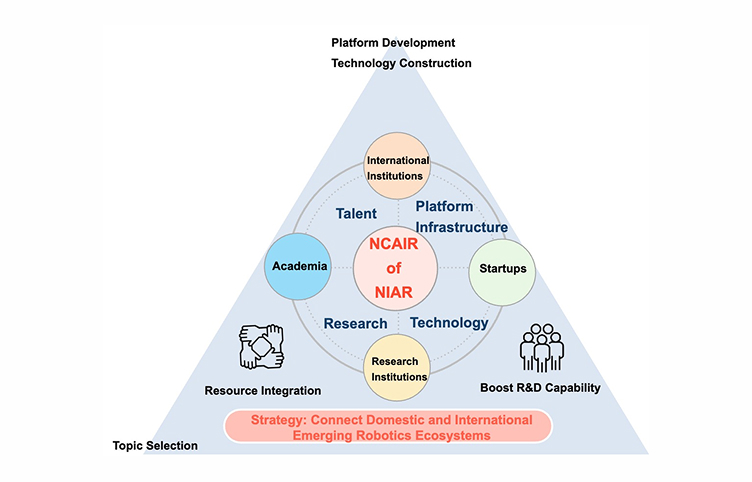
Develop Robotics Talent
Establish interdisciplinary, hands-on training programs in:
-
Cloud computing
-
Edge computing
-
Robotics software
-
Robotics hardware
-
Mechatronics and system integration
NCAIR will collaborate with universities, government agencies, research institutions, and industry to provide professional training and train-the-trainer programs.
NCAIR will also promote international research exchanges and robotics internship programs for graduate students from Taiwan and abroad.
NCAIR’s indoor and outdoor facilities will support robotics competitions, technical events, and international conferences, providing an environment where emerging talent can develop and demonstrate robotics technologies.