Purpose and Expected Outcomes
In line with the Executive Yuan's "AI New Ten Major Infrastructure Development Program" and "Smart Robotics Industry Promotion Program".
Purpose
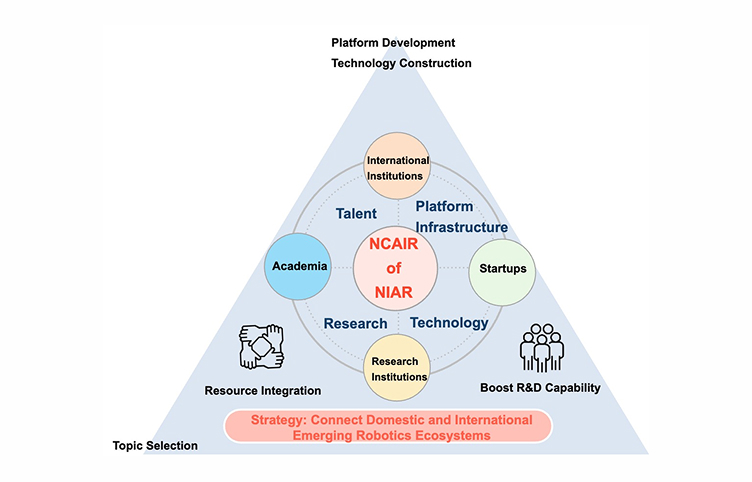
To establish the National Center for AI Robotics (NCAIR) under the National Institutes of Applied Research (NIAR), integrating domestic and international industry-academia-research ecosystems in AI robotics. The Center aims to develop frontier technologies, establish shared research infrastructure, and cultivate a new generation of system-capable startups — driving Taiwan's robotics industry toward global competitiveness.
Necessity
The Center serves as a critical catalyst connecting Taiwan's industry, academia, and research sectors in AI robotics, addressing three strategic needs:

Enhancing Human Well-being
Addressing labor shortages through the development of medical, elderly
care,
and companion robots to improve quality of life
Plans & Objectives
Develop intelligent medical robots, eldercare and companion robots in
collaboration with healthcare institutions for real-world testing and deployment

Integrating Talent
Establishing cross-disciplinary research agendas to attract collaboration
from
international and domestic experts
Plans & Objectives
Provide testing environments, industry-academia talent cultivation
mechanisms,
and international student exchange research programs to attract top-tier researchers
Technology & System Deployment
Developing proprietary hardware and software modules, establishing
simulation
and physical test environments to bring robotics technology into real-world applications
Plans & Objectives
Industry-academia-research consortium to establish international
robotics test
sites and support startup incubation
Center Vision
Co-Research, Co-Creation,
Co-Sharing, Leading Smart Robotics Technology Cross-Collaborative Innovation, Shared Knowledge, Global Leadership
Co-Sharing, Leading Smart Robotics Technology Cross-Collaborative Innovation, Shared Knowledge, Global Leadership
Cross-disciplinary Co-Research
Build a cross-domain AI robotics research collaboration platform to
advance
frontier technology development and integration.
Collaborative Co-Creation
Facilitate industry-academia-research joint innovation to accelerate
breakthroughs in core robotics technologies and enable practical deployment.
Knowledge Sharing
Build talent development and knowledge sharing mechanisms to
comprehensively
enhance Taiwan's AI robotics research capabilities.
Global Leadership
Connect with emerging robotics ecosystems worldwide, positioning
Taiwan as a
global leader in intelligent robotics.
Milestones of NCAIR
115
Establishing a Software-Hardware Co-Pilot Testbed for Small-Scale
Robots
Establishing a digital twin simulation training environment with
complete toolchain integration and introductory training courses. Deploying robotics operating
systems on
domestic embedded platforms. Reference hardware designs for specialized robot platforms. Defining
robot
technology requirements.
116
Developing a Shared Platform for Integrating Advanced Robotic
Technologies
Cloud platform and training field synchronization. Establishing
ecosystem migration for domestic-chip-based robotics operating systems. Providing AI model
demonstrations
with real-time training courses.
117–118
Promoting a Talent Cultivation Platform for Robotic Science and
Technology
Providing source vision model approximation on embedded systems.
Completing hardware field testing with industry partners. Cloud-edge-hardware integration.
Completing
multi-purpose service robot deployment in physical test environments and seeking real-world field
testing
with industry partners.
Policy Reference
2026/04
Inauguration of NCAIR
In accordance with the Executive Yuan's "AI New 10 Major Infrastructure
Program"
and "Smart Robotics Industry Promotion Program," the National Center for AI Robotics was officially
established under NARLabs, integrating domestic and international industry-academia-research
robotics
ecosystem capabilities.
2025/08
Inauguration of the NCAIR Preparatory Office
The NCAIR Preparatory Office was officially inaugurated, representing a
milestone
in Taiwan's intelligent technology development. The Center pledges to serve as a catalyst connecting
the
domestic and international robotics ecosystem for industry, academia, and research.
2025/07
Executive Yuan Approved the "Smart Robotics Industry Promotion Program"
The NSTC was tasked with planning the establishment of the Smart Robotics
Research
Center at the Shalun AI Industrial Zone to enhance Taiwan's robotics R&D capabilities and link
with
emerging robotics ecosystems domestically and internationally.
2025/01
National Development Council Cross-Ministerial Smart Robotics Promotion
Meeting
The NSTC formulated and took charge of promoting the "Smart Multi-Function
Robotics
Program" to build domestic robotics industry capabilities and achieve technological self-reliance.
Leadership Team

Vice President and Director General / 副院長兼任代理主任
Chun-Liang Lin
Education
Ph.D. in Aeronautics and Astronautics, National Cheng Kung University
Master’s Degree in Department of Automatic Control Engineering, Feng Chia University
Bachelor's Degree in Department of Electronic Engineering, Feng Chia University
Experience
Domain Expert, Engineering Strategy Group, Science and Technology Policy Advisory Office, NSTC
Chair and Distinguished Professor, Department of Electrical Engineering, NCHU
Vice President for Academic Affairs, VP Office, NCHU
Vice President for Administrative Affairs, VP Office, NCHU
Chief Information Security Officer, NCHU
Director, Office of Sustainability, NCHU
Director, General Center for Academia-Industry Collaboration, NCHU
Chairman, Department of Electrical Engineering, NCHU
Vice Dean, Office of Research and Development, NCHU
Director General, National Space Organization (NSPO), NARLabs
Distinguished Research Fellow, NARLabs
Convener, Control Engineering Division, Department of Engineering and Technologies, MOST
Distinguished Research Fellow, NSTC
Convener, Key Technologies for Unmanned Aerial Vehicles Forward-looking R&D Project, NSTC
Co-convener, CubeSat Key Technologies R&D Project, NSTC
Founding President, Taiwan Space Industry Development Association (TSIDA)
Vice President, Chinese Automatic Control Society (CACS)
IET Fellow, CACS Fellow, AAS of ROC Fellow

Deputy Director / 副主任
Huang, Chi-Hung
Education
Ph.D., Power Mechanical Engineering, National Tsing Hua University
Experience
Researcher, National Instrument Technology Research Center
Division Chief, Taiwan Instrument Technology Research Center
Deputy Director, Instrument Technology Research Center
Division Chief, Instrument Technology Research Center
Vice Chair, Education Committee, IEEE Instrumentation and Measurement
Society
Innovation
Tuesday Theme
Enhancing Human Well-Being: Solving Labor Shortages through Smart
Robotics
Development
Develop intelligent healthcare, eldercare, and companion robots to
address
Taiwan's aging population and labor shortage challenges.
Purpose
Develop AI-driven medical and eldercare robots for hospital and home
environments
Partner with healthcare institutions for real-world testing and
iterative
improvement
Plan
Phase 1: Prototype development and safety certification
Phase 2: Clinical pilot programs with partner hospitals
Phase 3: Commercial deployment and ecosystem expansion
Tuesday Theme
Integrating Talent: Building Cross-Disciplinary Research Networks
Establish research programs that bridge engineering, medicine, social
science,
and design disciplines to create holistic robotics solutions.
Purpose
Create joint research initiatives across universities and research
institutes
Attract international scholars and industry experts as visiting
researchers
Plan
International fellowship programs for graduate students
Annual cross-disciplinary robotics symposium
Industry mentorship program pairing startups with established firms